
Ellicott City Wood Flooring has repaired hardwood floor water damage in Ellicott City, MD for more than 20 years, serving surrounding cities including Catonsville, Woodlawn, Columbia, Ilchester and Milford Mill. When a supply line bursts, a dishwasher leaks for weeks or a storm sends water into the basement, we find where the water went, dry the floor properly and repair only what will not recover.
Water damage is the job where rushing costs the most. A floor sanded or replaced before it has dried will move again, and a floor torn out too quickly can lose boards that would have come back on their own. We work from moisture readings rather than appearance, because a floor can look dry on top while the subfloor beneath it is still wet.
Every water damage job is documented room by room. You get the readings, photos and an itemized estimate that separates boards needing replacement from areas that only need refinishing, so your adjuster has a clear record of what failed and why.
Signs a Hardwood Floor Has Taken On Water
Cupping and crowning
Cupping is when the edges of each board rise higher than the center, giving the floor a washboard look. It happens when the underside of the board is wetter than the top, usually because water got under the floor or moisture is rising from below. Cupping is often the first sign of a slow leak that nobody has noticed yet.
Crowning is the opposite: the center of each board sits higher than the edges. It most often appears after a cupped floor was sanded flat before it dried, and the boards then shrank back. That is the clearest example of why we dry first and decide second, because crowning caused by early sanding can only be fixed with another sanding or with replacement.
Buckling and lifting
Buckling is the most severe reaction, when boards swell so much they push against each other and lift off the subfloor, sometimes several inches. It usually follows standing water or a flood. Buckled boards are often damaged beyond saving, and the fasteners holding them may have torn through the subfloor.
Even so, buckling in one room does not always mean the whole floor is lost. We map where the moisture actually reached, which can be a smaller area than the visible damage suggests, and plan replacement around the boards that will not recover rather than the entire room.
Water stains, gaps and smells
Dark water stains, black rings around plant pots and gray patches near doors are signs that water has soaked into the wood itself. Light marks may sand out, while black stains usually mean the water has reacted with the wood deep in the board. Board gapping and cracked finish along the seams can also follow a wet floor once it dries.
A musty smell after a leak deserves attention. It can mean moisture is trapped under the floor where mold can grow on the subfloor or the underside of the boards. We check for it before closing anything up, and recommend a remediation professional if we find it.
Our Step-by-Step Hardwood Floor Water Damage Process
Step 1: Find and stop the source
No drying plan works while water is still arriving. We trace the moisture back to its source, whether that is a supply line, an appliance, a radiator, a window, a roof leak or groundwater, and make sure it has been stopped or repaired by the right trade. We also note how long the water was likely present, because that affects how deeply it has soaked in and how the floor is likely to respond.
Step 2: Map the moisture
With a moisture meter, we take readings across the floor and beyond the visible damage, along with readings on the subfloor where we can reach it. Those readings show how far the water spread and give us a dry reference from an unaffected room.
That map becomes the baseline for everything that follows. It tells us which boards may recover, which almost certainly will not, and where to watch most closely while the floor dries.
Step 3: Dry and monitor
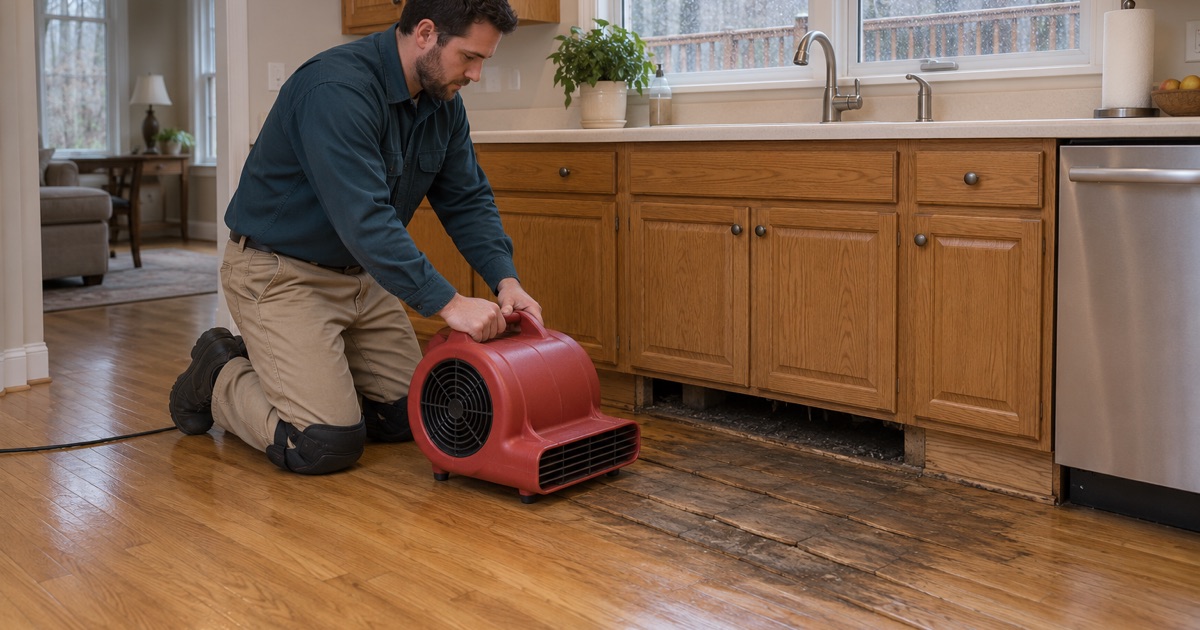
The floor is dried with air movement and dehumidification, and in some cases by removing a few boards so air can reach the subfloor. We take readings again over the following days and compare them with the dry reference until the floor and subfloor are back in range.
Patience here saves money. Boards that have flattened out on their own can simply be refinished, which is far less work than replacing them.
Step 4: Document for the adjuster
We record the source, the moisture readings at each visit and the condition of each room, with photos. That record goes with an itemized estimate that lists replacement, repair and refinishing as separate lines, room by room.
Step 5: Repair, refinish or replace
Once the floor is dry, we replace the boards that did not recover, weave the new boards into the existing floor and refinish the area so it blends. Where the subfloor or joists were damaged, those repairs come first.
Repair, Refinish or Replace
Floors that dry back and refinish
Many floors that cupped after a modest leak settle back close to flat once they dry. A full sand through the grit sequence then removes the remaining unevenness and any light stains, and a new finish makes the room look as though nothing happened.
The key is waiting until the readings say the floor is ready. A refinish over wood that is still drying will crack or cup again within a season.
Board replacement and weave-in repair
Boards that stayed cupped, turned black or split are cut out and replaced. We remove them in staggered lengths and weave new boards in so the joints follow the existing pattern, rather than cutting a square patch that stands out from across the room.
New boards are acclimated to the house before installation, then the whole affected area is sanded and finished together. Matching species and width matters as much as color; a red oak floor patched with white oak will never blend, whatever the stain.
Engineered floors and basements
Engineered hardwood that soaked up water often delaminates, with the top wood layer separating from its core. That damage does not reverse, so those boards are replaced. In finished basements, we look at whether wood is still the right floor before putting it back.
If the basement has taken on water more than once, we read the moisture and the grade and may recommend engineered wood with better vapor protection or a floor that handles water better than wood. Replacing a basement floor with the same thing that just failed rarely makes sense.
Water Damage in Ellicott City Homes
Flash floods along the stream valleys
Ellicott City’s historic Main Street flooded severely on July 30, 2016 and again on May 27, 2018. The USGS measured 6.60 inches of rain in 3 hours during the 2016 storm and 6.56 inches in 3 hours in 2018, and both floods caused significant damage to buildings. Homes near the Tiber, Hudson and New Cut branches know how fast that water arrives.
After the 2016 flood, Howard County’s repair guidance listed replacing floor finishes among the work that did not need a permit, while structural repairs found along the way did. We follow the same logic: floor work goes ahead once the structure under it has been checked.
Basements, sump pumps and storms
A failed sump pump during a heavy storm can put inches of water across a finished basement in an afternoon. Basement floors sit on concrete that holds moisture long after the visible water is gone, so we read the slab before any new floor goes back down.
Slow leaks inside the house
Most water damage we see is not a flood at all. It is a dishwasher line, a refrigerator ice maker, a leaking toilet seal, a radiator valve or a window that has let in rain for months. These leaks usually show as cupping in a small area long before anyone sees water, and catching them early keeps the repair to a few boards rather than a whole room.
- 20+ Years on Wood Floors
- Written, Itemized Estimates
- Dust Sealed Into the Work Area