
Ellicott City Wood Flooring installs herringbone wood floors in Ellicott City, MD, along with chevron patterns and wide plank floors, and has worked on wood floors here for more than 20 years, serving surrounding cities including Catonsville, Woodlawn, Columbia, Ilchester and Milford Mill. These are the floors where layout and preparation matter most, because every flaw in the subfloor or the plan shows up across the whole room.
A herringbone floor is built from a centerline outward, so the first decision is where that line goes. A wide plank floor is built on acclimation and fastening, because broad boards move more than narrow ones. We plan both on paper before a single piece is cut. The estimate is written and itemized, with the pattern labor shown separately so you can compare it with a straight-laid floor of the same wood.
Herringbone and Chevron Patterns
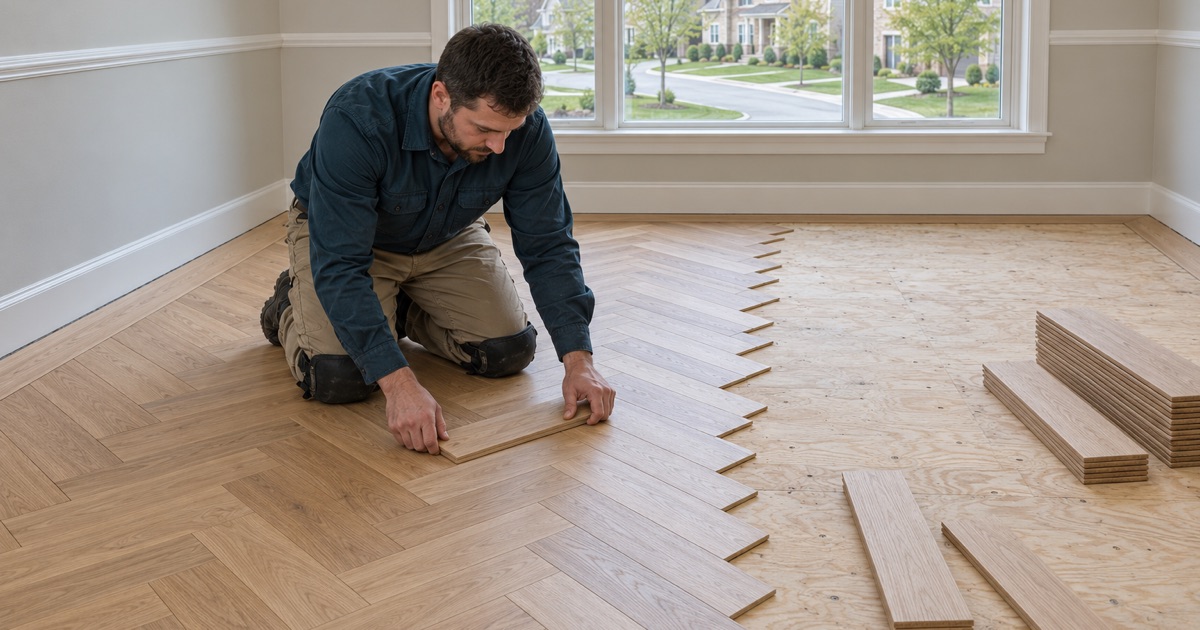
How the patterns differ
Herringbone is laid from rectangular pieces with square ends, each end butting against the side of the next to form a woven zigzag. Chevron uses pieces with angled ends that meet in a clean point, forming a continuous run of V shapes. The two look similar in a photo and very different in a room.
Herringbone feels traditional and textured; chevron feels more directional and modern. We bring sample layouts so you can see both at the scale of your room before deciding.
Laying out from a centerline
A pattern floor looks right only when it is centered on what the eye sees first: the main doorway, a fireplace, a long hall. We snap a centerline from that point and work outward, so the pattern meets the walls evenly on both sides rather than ending in a sliver along one wall.
In connected rooms, we decide whether the pattern flows continuously from room to room or is framed separately in each space. That choice is made at layout, not halfway through installation.
Borders and transitions
Many herringbone floors are framed with a border of straight boards around the edge of the room. A border hides the cut ends of the pattern, gives the room a finished edge and makes transitions into hallways and other rooms much cleaner. It also helps where walls are not perfectly square, which is common in older houses.
Borders can be as simple as two rows of matching boards or as detailed as a contrasting species with a feature strip. We size the border so the pattern field stays centered and the border reads as deliberate rather than as filler where the pattern ran out.
Preparing the Subfloor for a Pattern Floor
Flatness matters more
Short pattern pieces follow every dip and hump in the subfloor, and their many joints make unevenness easy to see. We check the subfloor with a straightedge, fill low spots, grind high ones and fasten loose panels before layout begins. A pattern floor is only as flat as what lies beneath it.
We also confirm the subfloor is fastened tightly to the joists, since a pattern floor has many more short pieces that can squeak against a loose panel. Fixing that now takes minutes per panel; fixing it after the pattern is down means lifting finished work.
Concrete and moisture
Over a concrete slab, herringbone is usually installed with engineered pieces glued directly to the prepared concrete. We take moisture readings on the slab first and select the adhesive and any vapor protection from those readings. Solid pieces are kept to wood subfloors above grade.
A finished basement is a below-grade installation, and we are cautious there even with engineered pieces. If the slab readings are high or the basement has taken on water before, we may recommend a different floor for that level and save the pattern for a room upstairs.
Wide Plank Floors
White oak, pine and other species
Wide plank floors in white oak, pine and other species show more of each board’s grain and give a room a calmer, broader look than narrow strip. White oak is hard and stable for its type and takes natural and gray tones well. Pine is softer and dents more easily, which many people accept as part of its character.
Board length matters as much as width. Long boards make a wide plank floor look calm and continuous, while many short ones create a busier look with more end joints. We rack out boards from several bundles before installation so lengths and color vary naturally across the room.
Movement across the width
A board moves across its width as humidity changes, and a wide board moves more than a narrow one. That means larger seasonal gaps in winter and a greater risk of cupping in a humid summer. We acclimate the boards in the house, check them with a moisture meter, and fasten them following the NWFA Installation Guidelines, which call for additional fastening on wider boards.
Keeping indoor humidity steady through the year is the single best protection for a wide plank floor. We talk through what that means for your house before you choose solid over engineered.
Solid or engineered wide plank
Engineered wide plank gives the same look with much less movement, because its cross-laminated core resists swelling and shrinking. It is our usual recommendation over concrete, in basements and in large open rooms. Solid wide plank remains a good choice over a wood subfloor in a house with steady humidity.
Finishing Pattern and Wide Plank Floors
Site-finished for a seamless surface
Site-finished pattern floors are sanded flat after installation and finished in place. Because the grain changes direction in herringbone and chevron, the sanding sequence is the same careful one we use on parquet, with final passes made by machines that cut evenly in every direction.
Prefinished herringbone and wide plank are also available and go into use immediately, with no sanding dust or fumes in the house. They carry a small bevel at each edge, which on a pattern floor adds a fine grid of lines, so we show you both finished surfaces side by side before you choose.
Choosing stain and sheen
A pattern floor catches light differently from piece to piece, and stain can make the pattern bolder or softer. We lay stain and sheen samples on the installed floor so you can see the effect in your own light. Finishes are chosen to fit Maryland’s VOC limits for wood coatings, with drying times planned around the household.
- 20+ Years on Wood Floors
- Written, Itemized Estimates
- Dust Sealed Into the Work Area