
Ellicott City Wood Flooring has helped homeowners replace carpet with hardwood in Ellicott City, MD for more than 20 years, serving surrounding cities including Catonsville, Woodlawn, Columbia, Ilchester and Milford Mill. We handle single bedrooms, whole upper floors, family rooms and carpeted stairs, from removal through the finished floor.
The first question is always what sits under the carpet. Sometimes it is a plain plywood subfloor ready for new wood; sometimes it is an oak floor that has been hidden for decades and only needs refinishing. We check before quoting, because finding a good hardwood floor under the carpet can save you the cost of a new one. Every job is priced in a written, itemized estimate that separates removal, subfloor work, new flooring, stairs and finishing.
What Is Under the Carpet
Hidden oak worth refinishing
In older houses, carpet was often laid straight over red oak strip flooring. That wood has been protected from traffic and sunlight for years and is frequently in better condition than any exposed floor in the house. Tack strip holes and staples around the edges are filled, and the floor is sanded and refinished like any other hardwood.
When we find hidden oak, we tell you before going further. Refinishing an existing floor almost always costs less than installing a new one, and the result is a solid hardwood floor original to the house.
A plywood or particleboard subfloor
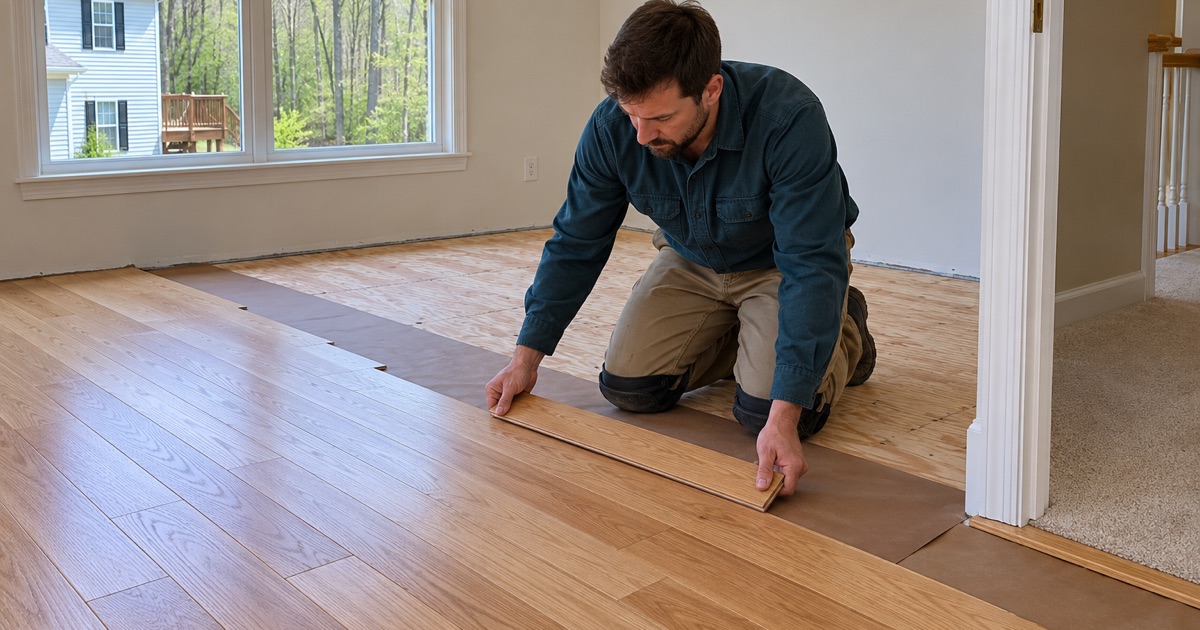
In many homes built in the 1980s, 1990s and 2000s, carpet sits directly on a plywood or particleboard subfloor. That is a normal base for new hardwood, provided it is flat, firmly fastened and dry. Particleboard can be a poor base for nailed flooring, and we may recommend new plywood over it.
We also look at how the subfloor panels meet the joists below. Panels that flex between joists or have swollen at the edges from an old spill will show through hardwood as soft spots and squeaks, so they are refastened or replaced before any flooring is ordered.
Old tile and adhesive
Sometimes carpet covers an older layer of resilient floor tile or black mastic. Those materials can contain asbestos, so we stop and have them identified before anything is sanded, scraped or covered. Their removal belongs to a qualified trade, and we resume once that has been handled.
Choosing the Floor That Replaces It
Solid hardwood for bedrooms and living areas
Above grade, over a wood subfloor, solid hardwood is the natural choice. It can be sanded and refinished many times, and it can be stained to match an existing floor elsewhere in the house. Red oak and white oak are the most common species, with maple and wider boards as alternatives.
If the rest of the house already has hardwood, we usually recommend matching its species and width and site-finishing the new floor, so the old and new rooms read as one continuous floor.
Engineered hardwood for basements and slabs
Carpet in a finished basement or over a concrete slab is usually replaced with engineered hardwood rather than solid. We take moisture readings on the concrete before any wood goes down, and the readings decide the installation method and vapor protection, or whether a different floor is the better choice.
Removal and Subfloor Preparation
Taking out carpet, pad and tack strip
Carpet removal sounds simple, but what is left behind matters: carpet pad residue, staples every few inches and tack strip nailed around every wall. All of it comes out, and the subfloor is scraped and cleaned so nothing telegraphs through the new floor.
Removal is also when we check the build year. In houses built before 1978, painted baseboards and shoe molding can contain lead, and pulling tack strip or trim can disturb them. Where that applies, we plan the removal and cleanup under the EPA RRP Rule rather than tearing out first and asking later.
Flattening and quieting the subfloor
Carpet hides a lot. Once it is up, we check the subfloor for dips, humps, loose panels and squeaks. Low spots are filled, high spots ground down, and loose areas screwed to the joists. A squeak left in the subfloor becomes a squeak in the new hardwood.
This is also the moment to find old water damage. Stains or soft spots near bathrooms and exterior doors are read with a moisture meter and repaired before the new floor goes down.
Heights at doors, stairs and other floors
Hardwood and carpet rarely finish at the same height. We measure door clearances, thresholds and the top of the stairs, and plan reducers, thresholds or trimmed doors so the new floor meets tile, vinyl or remaining carpet without a trip edge.
Carpeted Stairs and Upper Floors
Turning carpeted stairs into hardwood
Stairs are often the last carpet left in a house. We remove it, check whether the treads beneath are finish-grade, and either refinish them or install new hardwood stair treads, risers and nosing. Stairs are quoted tread by tread, since a staircase is not priced by the square foot.
Townhouses and condos
In townhouses and condos, replacing carpet with hardwood can change how much footstep noise reaches the room or unit below. We read the association’s documents for flooring and underlayment rules and choose sound-reducing underlayment to meet them.
The Ellicott City census area counts more than 5,000 single-family attached homes, and many of them were delivered with carpet on every upper level. Those bedrooms and halls are usually straightforward conversions over plywood, and planning the order of rooms lets the household keep sleeping upstairs while the work moves through.
Living Through the Change
One room at a time or a whole level
Many homeowners replace carpet in stages: bedrooms one year, the hall and stairs the next. We plan each stage so it can connect to the next later, leaving the boards at the doorway ready to weave into without a seam.
Dust and finishing
Site-finished floors are sanded and coated in place, with dust contained to the rooms being worked on and doors and returns sealed. We use finishes that fit Maryland’s VOC limits for wood coatings and give you the drying schedule before we start, so you know when each room can be used again.
If you would rather avoid finishing fumes in the house, prefinished hardwood is the alternative. It goes down already coated and can be walked on as soon as it is installed, though it will not match an existing site-finished floor as closely. We lay out both options before you choose.
- 20+ Years on Wood Floors
- Written, Itemized Estimates
- Dust Sealed Into the Work Area