
Ellicott City Wood Flooring has provided screen and recoat service for hardwood floors in Ellicott City, MD for more than 20 years, serving surrounding cities including Catonsville, Woodlawn, Columbia, Ilchester and Milford Mill. A screen and recoat restores a floor whose finish is dull and scratched but still intact, without sanding into the wood.
It is the most overlooked service in wood flooring. Done at the right time, a recoat costs a fraction of a full refinish, disrupts the house for far less time, and removes no wood at all, which matters on old strip floors and on engineered floors with a thin wear layer. Done at the wrong time, it peels.
We tell you honestly which one your floor needs. If a full sand is the right answer, we say so; if a recoat will do, we will not sell you more.
What a Screen and Recoat Does
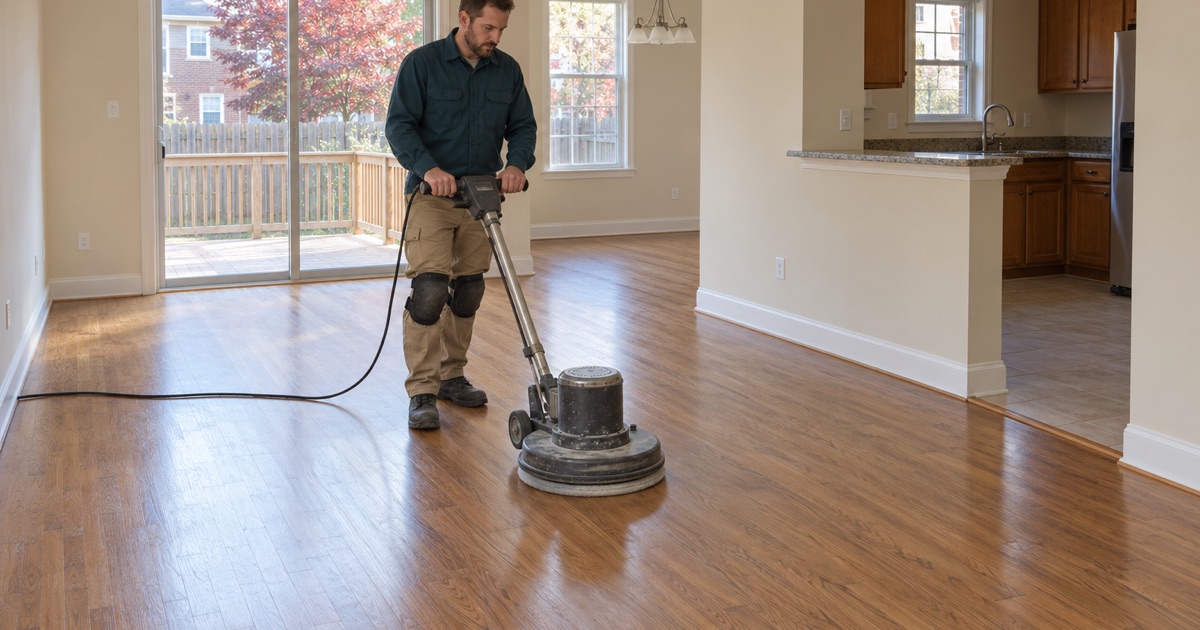
Abrading the existing finish
The floor is cleaned, then the existing finish is lightly abraded with a buffer fitted with a sanding screen or pad. That roughs up the surface so the new coat can grip it, and it smooths out fine scratches in the old finish.
The abrasion stays in the finish layer. It does not reach the wood, does not change the color, and does not remove dents or deep scratches. What it does is give the new coat a clean, even surface to bond to.
Adding a fresh coat of finish
After the dust is removed with a HEPA vacuum and a tack cloth, a new coat of polyurethane goes on. The result is a floor with a uniform sheen and a fresh protective layer, ready to take another stretch of daily wear.
We match the new finish to the existing one where that matters for bonding, and we can change the sheen level at the same time if you want a more matte or a slightly brighter look.
When a Recoat Is the Right Choice
Dull traffic lanes but no bare wood
The best candidate is a floor with dull traffic lanes, fine scratches and a worn sheen, but with finish still covering the wood everywhere. Walk the main paths: if you see gray, bare wood in a hallway or at the kitchen sink, the finish has worn through and a recoat will not cover it evenly.
Catching a floor at this stage is what makes recoating worthwhile. A floor recoated every few years can go a very long time between full sandings.
Floors with little wood left to sand
Old strip floors that have been sanded many times may have little wood above the tongue. Engineered floors with a thin wear layer may not survive a full sand at all. For both, a screen and recoat adds protection without removing anything, which extends the life of a floor that cannot afford another sanding. We check the remaining wood at a floor register or threshold before recommending either service, so the choice is based on measurement rather than a guess.
When a Recoat Will Not Work
Wax residue and polish buildup
Polyurethane will not bond to wax residue, and many household polishes leave silicone or acrylic films that cause the same problem. A recoat applied over them can peel away in sheets within weeks. That peeling polyurethane is the most common recoat failure we are called in to fix.
We test the floor for wax and polish before agreeing to a recoat. If they are present, the only reliable fix is a full sand to bare wood, and we explain why rather than taking the job and hoping.
Damage that is in the wood
A recoat cannot remove pet urine stains, water stains, deep scratches, dents or the orange tone that older oak takes on. Those live in the wood itself, beneath the finish. If any of them bother you, a full refinish is the service that addresses them.
Sometimes the answer is a mix. A floor that is sound in the bedrooms but stained by a pet in the living room can be recoated in some rooms and fully sanded in others, provided the sheen is matched where the two meet. We lay that out room by room in the estimate.
Factory finishes on prefinished floors
Many prefinished floors carry hard factory coatings that ordinary polyurethane struggles to grip, even after screening. Those floors need a bonding treatment or a specific recoat system before a fresh coat will hold. We identify the product where we can and test a small area before committing the whole floor.
Planning a Recoat Around the Household
A shorter disruption
A screen and recoat is usually a short visit, and furniture can return sooner than after a full refinish. That makes it a good fit for occupied homes, rental turnovers with a tight window, and floors that need to look fresh before a listing.
Rooms still need to be cleared, and the new coat still needs drying time before socks, then furniture, then rugs. We give you that schedule in writing before we start.
Finishes and fumes
We choose finishes that fit Maryland’s VOC limits for wood coatings and plan the coat around the household. Waterborne polyurethane carries less odor and dries quickly, which suits a family staying in the house, while an oil-modified finish may be the better match on a floor that already has one.
The dust from screening is far lighter than from sanding, but it still matters, because any grit left on the floor ends up locked under the new coat. We seal doors and returns in the rooms being worked on, vacuum with a HEPA vacuum and wipe the floor before a drop of finish goes down.
Keeping the new coat looking good
After a recoat, felt pads under furniture, mats at entry doors and a cleaner made for polyurethane keep the finish clear. Avoid wax and wet mopping; both are what make the next recoat impossible. With that care, the floor can be recoated again when the traffic lanes dull, rather than needing a full refinish.
- 20+ Years on Wood Floors
- Written, Itemized Estimates
- Dust Sealed Into the Work Area